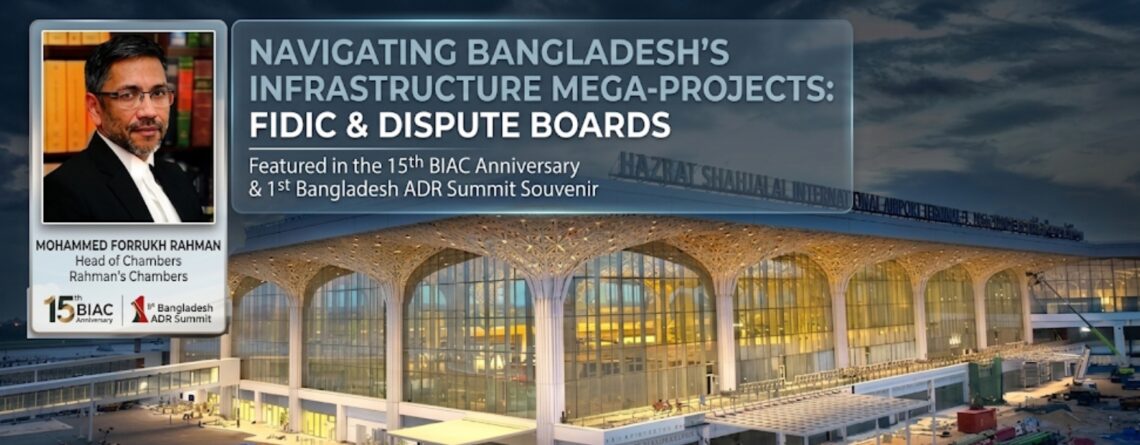
Featured in the official magazine commemorating the 15th BIAC Anniversary and 1st Bangladesh ADR Summit 2026, an insightful article by Mohammed Forrukh Rahman—Head of Chambers at Rahman’s Chambers—examines the legal and operational architecture required to deliver Bangladesh’s mega-infrastructure projects. As the nation undergoes rapid economic transformation through deep-sea ports, mass rapid transit (MRT) systems, power generation plants, and airport expansions, modernizing dispute resolution frameworks is no longer optional—it is a project imperative.
The Standard of Choice: The FIDIC Suite in Bangladesh
Large-scale capital investments require a universal contractual language to balance risk and govern complex project matrices. In Bangladesh, public procurement entities and multinational consortiums rely heavily on the International Federation of Consulting Engineers (FIDIC) suite of contracts:
-
FIDIC Red Book (2017/2022): The benchmark for traditional civil engineering where the employer retains design responsibility, such as bridges and highways.
-
FIDIC Yellow Book (2017/2022): Deployed for complex plant and design-build projects like water treatment facilities and MRT systems.
-
FIDIC Silver Book (2017/2022): Utilized for EPC/Turnkey projects where total price and completion date certainty are paramount.
-
FIDIC Pink Book (MDB Harmonised Edition): Widely adopted in multilateral-funded endeavors—such as major aviation infrastructure—to align international banking requirements with standard civil conditions.
Adhering to The FIDIC Golden Principles (2019) ensures that custom amendments do not distort this fundamental allocation of risk.
Dispute Boards: Safeguarding Cash Flow and Project Momentum
A defining feature of the FIDIC framework is its tiered dispute resolution mechanism, prioritizing real-time dispute avoidance over project-paralyzing litigation. Standing Dispute Boards—comprising independent, impartial experts—offer continuous oversight and render swift, technically sound decisions within an 84-day contractual timeframe.
Because cash flow is the lifeblood of the construction industry, the interim binding nature of Dispute Board decisions allows work to continue unhindered while preserving commercial relationships. Even when a party submits a Notice of Dissatisfaction within 28 days to preserve its right to arbitration, well-reasoned Dispute Board decisions frequently drive voluntary compliance and commercial settlements.
Managing Complexities & The Public-Private Intersection
Mega-projects generate significant administrative and legal complexities, from system integration challenges across live operational environments to multi-party sub-contractor delays. Furthermore, because domestic public employers operate under statutory finance regulations and sovereign audits, disputes often witness an intense intersection between private contract mechanics and public administrative law.
A Strategic Paradigm Shift: Early External Legal Engagement
In the Bangladeshi context, public and private entities traditionally engage external legal counsel only when arbitration is imminent. Relying solely on in-house teams during live project execution often leads to missed contractual notices, compromised claims, and procedural vulnerabilities.
Navigating forensic delay analysis, quantum calculations, statutory audit shields, and Dispute Board advocacy requires multi-disciplinary legal oversight from the day a contract is signed. Viewing Dispute Boards as proactive management tools rather than preliminary legal battlefields remains essential to securing both commercial success and Bangladesh’s long-term infrastructure goals.